



Copyright (c) 2025 Olga Lucia Ostos Ortiz

This work is licensed under a Creative Commons Attribution-NonCommercial-ShareAlike 4.0 International License.
NOVA por http://www.unicolmayor.edu.co/publicaciones/index.php/nova se distribuye bajo una licencia Reconocimiento No Comercial- Compartir igual
Así mismo, los autores mantienen sus derechos de propiedad intelectual sobre los artículos,
Declaración de privacidad.
Los nombres y las direcciones de correo electrónico introducidos en esta revista se usarán exclusivamente para los fines establecidos en ella y no se proporcionarán a terceros o para su uso con otros fines.
Advancing Toward Excellence in Biomedical Research
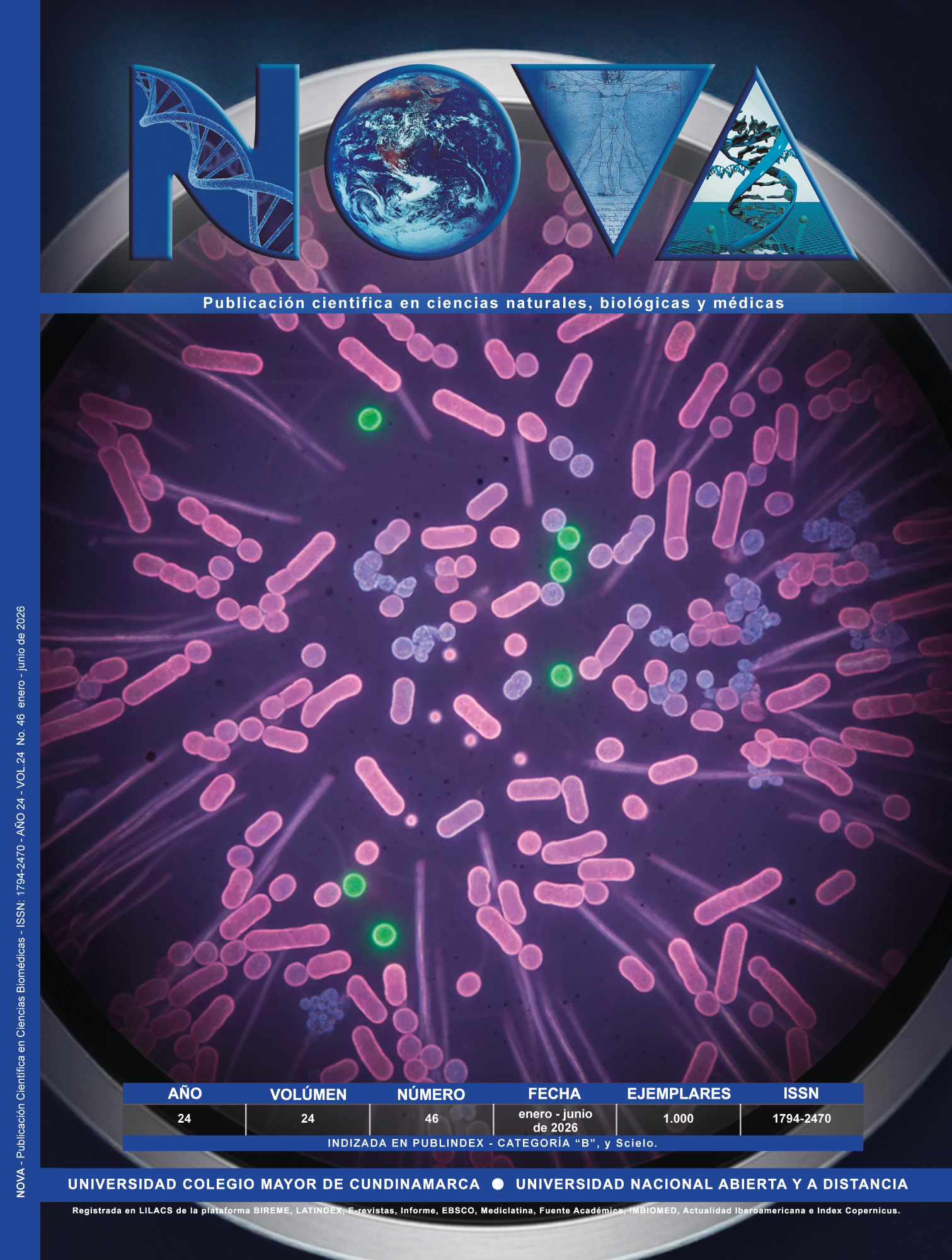
With great satisfaction, we present Volume 24, Issue 46 of Revista NOVA, corresponding to the year 2026—an edition that consolidates our publication’s commitment to the dissemination of high-quality scientific knowledge in the field of biomedical sciences.
This issue reflects the diversity and depth of contemporary research in the life sciences, encompassing topics ranging from technological innovations in biotechnology to epidemiological studies of public health relevance. The seven research articles and three review papers included herein demonstrate the application of rigorous methodological approaches to address complex problems across diverse biomedical disciplines.
The study “IoT Technologies Applied to the Cultivation of Pleurotus ostreatus, a Mushroom of Nutritional and Therapeutic Relevance, in Controlled Environments” represents a significant advance in integrating biotechnology with intelligent monitoring systems. The application of Internet of Things (IoT) technologies to optimize the cultivation conditions of Pleurotus ostreatus illustrates how automated systems can maintain optimal environmental parameters, minimize human error, and lay the groundwork for automated control in the production of functional mushrooms.
The research titled “Evaluation of Whey as an Alternative Substrate for the Production of Bacillus thuringiensis” contributes meaningfully to sustainability in biotechnological processes. The use of Bacillus thuringiensis as a biopesticide has gained global relevance due to its high specificity, stability, and biodegradability. The exploration of alternative substrates such as whey represents an innovative approach toward a circular economy in biotechnology.
The article “Effect of Culture-Medium Composition on the Antagonistic Capacity of Commercial Basidiomycetes Against Fusarium spp. and Alternaria alternata” provides fundamental insights into the biological control of phytopathogens. Characterizing the antagonistic activity of basidiomycete fungi against pathogens such as Fusarium and Alternaria is crucial for developing sustainable biocontrol strategies in agriculture.
The study “Characterization of Resistant Gram-Negative Bacilli Isolated from Health Institutions in the Department of Boyacá, Colombia” addresses a major public health concern. Bacterial resistance among Gram-negative bacilli has a significant economic and social impact, increasing both morbidity and mortality. The phenotypic characterization of regional resistance profiles is essential for implementing effective surveillance and containment strategies for antimicrobial resistance.
The article “Validation of the Analytical Method by HPLC for the Quantification of Meloxicam Traces in Manufacturing Equipment and Areas” underscores the commitment to analytical excellence in the pharmaceutical industry. The validation of analytical methods for detecting pharmaceutical residues is essential to ensure quality and safety throughout manufacturing processes.
The study “Emergency Triage Classification with Machine Learning: A Colombian Case” represents an innovative application of artificial intelligence in emergency medicine. Machine learning models have demonstrated superior predictive capacity for critical outcomes and hospitalizations compared to conventional systems such as the Emergency Severity Index, thereby enhancing triage accuracy and optimizing resource allocation.
The meta-analysis “Dyslipidemia in Patients Undergoing Gastric Bypass and Sleeve Gastrectomy” provides robust evidence on the effects of bariatric surgery on lipid metabolism. Results confirm significant improvements in lipid profiles following bariatric procedures, with remission of atherogenic dyslipidemia in a considerable proportion of patients.
Review Articles: Synthesis of Contemporary EvidenceThe article “Prevalence of Congenital Toxoplasmosis in Colombia: Systematic Review and Meta-Analysis” addresses a major public health issue of particular national relevance. This analysis of sixteen studies published between 2005 and 2022 revealed a weighted IgG prevalence of 38% (95% CI: 20–57%) among pregnant women and 39% (95% CI: 10–74%) among newborns, indicating high maternal exposure and a real risk of vertical transmission. The detection of IgM antibodies in 16% (95% CI: 7–27%) of pregnant women suggests recent, often asymptomatic infections that increase the risk of congenital sequelae. The high heterogeneity observed across studies reflects limited geographic coverage and diverse methodologies, revealing structural deficiencies in Colombia’s national epidemiological surveillance of this zoonosis.
The review “Microorganisms Associated with Endodontic Infections: Virulence, Resistance, and Persistence Factors” provides an updated synthesis of the microbial etiology of root canal infections. Enterococcus faecalis is identified as the most prevalent microorganism in secondary endodontic infections, with a prevalence of 36.6%, followed by Candida albicans, Propionibacterium acnes, and Veillonella parvula, with frequencies of 20%, 2%, and 2%, respectively. The review highlights that E. faecalis prevalence may reach 80–90% in certain clinical contexts. The global prevalence of Candida spp. in root canal infections was 8.20%, with C. albicans being the most frequently isolated species. In Colombia, endodontic-periodontal disease has a prevalence of 51.6%, occurring more frequently in women (51.8%) and predominantly affecting molars (40%).
The integrative review “Effort–Reward Imbalance and Burnout Syndrome in the Health Sector: An Integrative Review, 2018–2024” examines a critical issue in the contemporary healthcare system. The analysis of 22 studies revealed that most (90.9%) used quantitative, descriptive, and correlational methodologies. The most frequently studied professions were physicians (30.4%), followed by nurses (21.7%). The main findings show that younger men are more likely to develop professional burnout, while women are at greater risk of emotional exhaustion and overcommitment. Evidence consistently demonstrates that healthcare professionals experiencing greater effort–reward imbalance face a higher risk of developing burnout syndrome. The effort–reward imbalance model showed significant correlations with all burnout dimensions, with emotional exhaustion being the most strongly associated.
Strengthening of the International Editorial BoardA fundamental aspect of this issue is the recognition of the distinguished members of Revista NOVA’s editorial and scientific board, who have significantly strengthened our evaluation capacity and international projection.
We especially highlight the incorporation of renowned international researchers such as Dr. Ian James Martins from Australia, recipient of the 2024 Nobel Research Award and a neurobiology specialist with over 500 scientific publications and an h-index of 257; Dr. Arun Kumar from India, with more than 144 publications in cardiovascular biochemistry and editorial experience in multiple indexed journals; and Dr. Adham Farouk Mohammad from Egypt, an expert in plastic and reconstructive surgery with over 20 scientific papers and participation in humanitarian medical missions.
We express our deep appreciation to Dr. José Antonio Rodríguez Montes, a distinguished surgeon and scholar of broad international trajectory, with more than 270 articles, 29 books, and 120 book chapters published, as well as extensive leadership experience as department head and dean in prestigious European institutions.
The participation of Dr. Javier Aranceta Bartrina, President of the Spanish Academy of Nutrition, with more than 480 scientific publications and an h-index of 81, greatly strengthens our nutrition and public health areas. Dr. Francisco López Muñoz, Vice-Rector for Research at the Camilo José Cela University and member of over twenty international academies, with 798 scientific publications, consolidates our excellence in neuroscience and psychopharmacology.
Spanish researchers Dr. Antonio Bascones Martínez, President of the Royal Academy of Doctors of Spain, and Dr. Félix María Goñi Urcelay, a world leader in membrane biophysics with over 265 scientific papers, contribute high-level perspectives in both basic and clinical research.
Latin American representation includes Dr. Enrique Soto Eguibar from Mexico, a neurobiology specialist in the auditory system with 120 publications; Dr. Luis Jesús Villareal Gómez, an expert in biomaterials with over 60 publications; Dr. Claudia Gómez Acevedo, a behavioral pharmacology specialist; Dr. Gregorio Rodríguez-Boto Amago, Dean of Medicine at Nebrija University and 2025 National Medicine Award recipient in Neurosurgery; and Dr. Manuel Alfonso Patarroyo from Colombia, globally recognized for his pioneering work in synthetic vaccines with over 500 scientific publications.
The strengthening of our editorial board reflects the growth and international recognition of Revista NOVA, consolidating its position as a leading biomedical publication in the Ibero-American context. The combined expertise of these scholars, spanning from basic sciences to clinical applications, ensures a comprehensive and rigorous evaluation of scientific contributions.
Future PerspectivesThe works included in this volume illustrate the growing integration of advanced technologies in biomedical research—from IoT applications in biotechnology to artificial intelligence in clinical medicine. This ongoing trend toward digitization and process automation represents significant opportunities to enhance the efficiency, accuracy, and reproducibility of scientific research.
The evidence presented in the systematic reviews underscores the importance of multidisciplinary approaches to addressing complex public health challenges, from antimicrobial resistance to occupational health among healthcare professionals. These studies provide updated frameworks for decision-making in health policy and specialized clinical practice.
We invite the national and international scientific community to continue considering Revista NOVA as a privileged platform for disseminating their research, confident that this issue will make a significant contribution to the advancement of biomedical knowledge and to the training of new generations of researchers committed to scientific excellence and the improvement of human health.
Dr. Olga Lucía Ostos Ortiz, PhD
Editor-in-Chief
Revista NOVA
How to Cite